
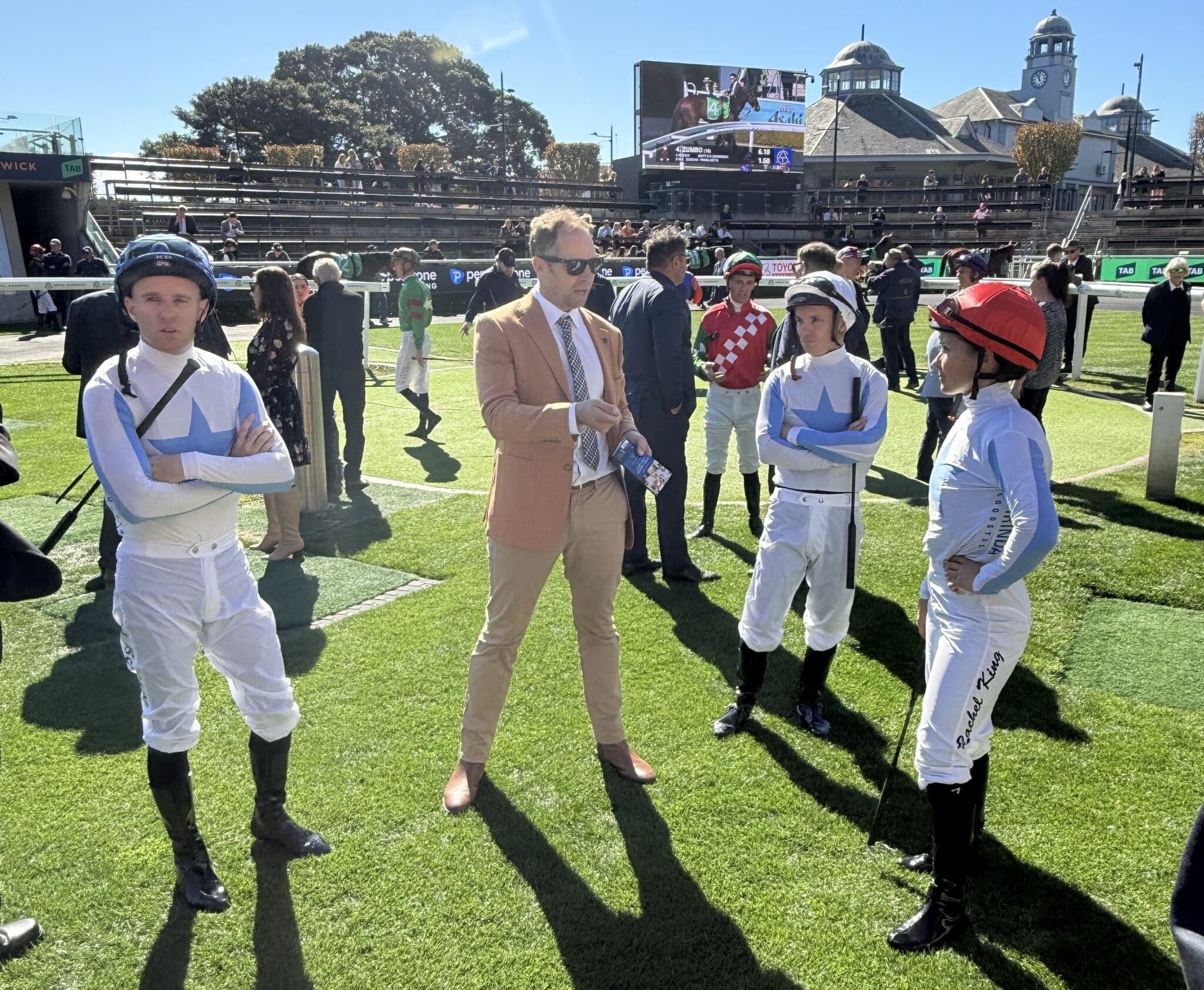
EPISODE 2 · Off “N” Racing
Matt Dale on Life as a Racehorse Trainer in Goulburn
Goulburn trainer Matt Dale talks about his swim dam, the move from Canberra, juggling family and training, and winning the Kosciuszko with Front Page.
14 December 2023 | 36 min | Matt Dale
Episode 2
Matt Dale on Life as a Racehorse Trainer in Goulburn
Also listen to this podcast on
TL;DR
Key takeaways
- Swimming adds fitness. Matt says swimming builds or maintains fitness without the concussion on feet and joints, and that it also stimulates a horse mentally
- Smaller on purpose. Matt says he keeps the stable to a number he can handle mentally, which helps him run the business and keep time for his family
- Weekly owner updates. Matt says weekly updates, plus notes after trials and races, have cut the phone calls from owners wondering what is happening with their horse
- Front Page and the Kosciuszko. Matt says he planned the preparation after being offered Front Page 14 weeks out, then managed a stone bruise with more swimming and treadmill work
- New people in the game. Matt says the slot concept brings new people into the game, and that the slot holders who chose Cavalier Charles had the time of their life
- 4.30am
- typical start time for his stable
- 14 weeks
- from the offer of Front Page to the Kosciuszko
- 19
- winners from his first 40 runners
- 2 km
- from Goulburn town to his farm
Jump to
In this episode
“It is 24-7. You couldn't do it if you didn't love it. It's as simple as that.”
Transcript
Full transcript
Read along or read instead of listening. Helpful if you are deaf or hard of hearing. Select a time to see where it sits on the player.
Matt Dale guestGeorge host
0:00 A typical training morning at Goulburn
George 0:00 We're here, episode 2 of the podcast, haven't been cancelled yet Sean. Off N Racing is the name of the podcast and we're in Goldburn here out at Mattie Dale's Farm. Mattie, thanks for joining us.
Matt Dale 0:14 My pleasure boys.
George 0:15 Mattie, we were just out at the racetrack watching a few horses of ours work and a few of your own and stuff. Is that a typical morning for you? Like what time do you start?
Matt Dale 0:25 Mattie Dale Yeah, look, that was a pretty typical morning. 4.30 kickoff for us and the staff get there and the horses are fed. They all get pre-walked and then it starts to saddle up and the system goes. So they all go out in lots of three or four. And like as you boys witnessed this morning, we had some course proper gallops. They were the horses going to the Saturday race meeting this Saturday and we had a few on the bee grass and a few on the sand. So it's good facilities there at Goulburn. It's a nice big open balanced track. So as we touched on, we just come out to the farm and had a look here, what we've got going on out here. On Goulburn Racecourse, we don't have a swimming pool. So we built a swim dam out here on our farm and we're able to bring horses out here that need to swim and also bring them out here and give them a few days in the paddock to freshen up. So on a hold this morning was a pretty usual morning for a Tuesday. Yeah.
1:20 Why Matt swims his horses
George 1:20 And what's, you mentioned the swimming pool and that you've put in a lot of facilities, a lot of money into the farm. What's the benefits of swimming one? Like what would, why would you swim one?
Matt Dale 1:31 Yeah, look, everyone's got their different opinions on swimming. It's a great addition to fitness without the concussion effect. So effectively you're increasing their fitness or at some stages maintaining their fitness without any extra pressure on the feet, joints, overall body. And it's also mentally a stimulating factor for a horse. I suppose, you know yourself, you go for a swim, you feel good. So a lot of horses really enjoy it from a mental side of things as well. We don't swim them because we're out on the farm here and we bring them out from the track. We probably swim them a little bit less often than I used to at Canberra, but the trip out and back actually stimulates them as well. So, um, no, we find it a really good tool and, um, when they need it, they need it. And a lot of gross horses that you want to just get that extra bit of fitness out of, like I say, without the extra pressure on their legs, the addition of swimming, it's not a replacement tool. It's an addition to your routines is really beneficial.
George 2:30 Yeah, no, it's a great asset. Definitely. As you said, it takes a lot of pressure off their legs and any, um, horses that might have niggly little issues or that. So yeah, huge benefit. And, um, you have a few other trainers that come out and use it.
Matt Dale 2:43 Yeah. Um, since I moved to Goulburn and we weren't, uh, we didn't have any stables on course, Danny Williams was kind enough to, um, lease me half of his barn. So Danny and I have got a, an agreement that, um, he's, he's sort of, he's helping me out in there and I help him out. He comes out and uses our swim, swim facility here as well. So that all works in well. And, um, yeah, so that's pretty much just us and Danny that use it and, uh, yeah, it works good.
George 3:10 And do you leave the algae in for Danny?
Matt Dale 3:13 No, we, uh, we keep it as clean as possible. Obviously it's a, it is a dam, um, but we've put a, uh, we've sort of worked it out what keeps it clean. And, um, we put an aerator in, which gets switched off when they're swimming and, uh, switch back on 24 seven outside of that. So there's a, there's a fountain in the middle of it that keeps the algae away and keeps it as clean as can be.
3:33 Moving from Canberra to Goulburn
George 3:33 How's the, uh, transition being from Canberra to Goulburn?
Matt Dale 3:36 Yeah, look, it was, um, something I never saw coming originally. I thought I was in Canberra for life, but, um, just with the limitations with the two main factors was, um, the workers comp insurance in Canberra was extremely excessive and the limiting factor of not being in the, um, highways or being at the bottom of the ballot for the highways. Week in, week out, we were getting sort of, um, it was quite frustrating, frustrating for owners, staff and myself. So, um, we found a nice property here in Goulburn and it's ended up being a great move. Um, great for the family. The kids really enjoying their schooling, their sports, great. And living on a farm, raising four kids. That's what we always wanted to do is give them a bit of room. So they ride the motorbikes, the horses and play tennis and basketball and, um, swim in the dam. So, uh, no, we love Goulburn. We now.
George 4:28 It's so beautiful. It's just so quiet, isn't it?
Matt Dale 4:30 It is. It's so peaceful. We were literally two kilometers out of town, but it feels like you, you could be, you know, hours out of town. So, um, we love it here. This is the forever home now. Um, and yeah, looking forward to keeping on, you know, keep building on things here at Goulburn. Yep. That's an alarm going off to tell me just to check my nominations are done. So you've got to sit around for every day.
4:54 Juggling family and a seven-day business
George 4:54 Yeah. Um, you mentioned there, you've got the young kids and everything, man. How do you juggle it? Sean would know as well having kids. I wouldn't, none that I'm claiming. Half the extent of that for you, man. I've only got two. Not as silly, but, um, no, how do you juggle like having a full-time family, obviously, and a full-time business that it is 24-7.
Matt Dale 5:15 Absolutely. It is 24-7. You couldn't do it if you didn't love it. It's as simple as that. Um, my wife, Amy, she does a great job with the kids. She, you know, four kids is more than a full-time job. It's probably two full-time jobs. But, so Amy looks after the kids side of things really well and lets me do, you know, run the business. And, um, but just being structured is a key and not being, for me, not being too big. Um, just maintaining a sort of certain number that I mentally can handle. Um, and I'm very sort of.
George 5:44 Kids' ways or horses' ways?
Matt Dale 5:45 Ah, yeah. Horses and kids, yeah. I think Amy wouldn't mind another one, but no, we're done. Four's enough. Four's plenty busy enough. But, um, no, look, it is a, it is a juggle and it's time management. And I'm always very organised with, you know, weekly, uh, work lists and everything's ahead of time. Um, you've got to be quite structured and, uh, but it is a 24-7 industry and it's, it's, it's hectic. So, it is a bit of a juggle. But we found Goulburn has helped us with that as well. Just, it's, uh, smaller than Canberra and just getting around town and getting to kids sporting events and, uh, whatnot has been a lot easier. And I don't always go to the races. So, on a Saturday sometimes I'll just send my staff up for the highway or whatever and I'll be going to watch my son play footy. I'll go to the track work, get everything done with the horses and then go and watch my son play footy and, and watch, um, you know, the highway on TV. So, you've got to prioritise because, uh, it's tough on families, this game. And you've got to sort of find, you know, what works for you and your family. And that's what we've done here.
George 6:45 And previously, like when you were at Canberra and that, did you find you were missing out on those events?
Matt Dale 6:49 Well, a little bit. If you try a little bit, yes. And the kids grow up so fast. So, you definitely have to, you've got to be mindful of it and try and get to as many, you know, things as you can. And, um, a lot of the work we do, like I say, my owners know how I operate and I'm at all the big race meetings and, and whatnot. And a lot of the country ones too, when we've got a lot of runners, but at the same time, I find from a time management point of view, um, the meetings I don't go to throughout the country, you know, week in, week out, uh, that I'm at home planning, programming, uh, getting on top of other things. And that helps the overall sort of running of the business. So, um, it's a lot of dead time traveling to and from the races. You can make a few phone calls, but yeah, you can't do a great deal of programming or, uh, you know, emails and things like that. So, um, yeah, I don't always go to the races and that's part of the time management with juggling the kids and the horses. Yeah. Yeah.
7:45 Growing up around racing
George 7:45 Did you always want to be a horse trainer?
Matt Dale 7:47 Yeah. I grew up wanting to be a jockey originally, um, but quickly out, outgrew that and just grew up going to the horse races from an early age. I can remember as from five year old, I went to the races every Saturday with my grandparents and just loved it. So it was in my blood from a very early age and, um, started gambling at that sort of age too. I mean, you look back and it sounds, I suppose gambling sounds like a bit of a, you know, a poison word to some people, but to me, it taught me early on how to sort of, um, manage money and expect, you know, risk and reward and all those sort of things. And I didn't look at it like gambling. I looked at it as entertainment. And if I had $4 to go to the races with, um, back then I'd look at it as, you know, a lot of your friends or, and as you're growing up, you know, five, six, seven, eight, nine, 10, your friends might go to the local store and buy lollies or go to the swimming pool or be playing pinball machines. So I'm getting a full day's entertainment, watching horses and watching a sport I love and being engaged. So I looked at it as if you lost it all, you've had a great day. And if you won, it's a bonus. So that, that actually put me in good stead growing up. Um, good for your maths as well. And, um, you know, grew up loving it and ended up going to Sydney university, um, their orange campus, which is their rural campus and, uh, studying equine business management. And that set a good platform to then sort of going in and going into a training operation. Yep.
George 9:16 And if you weren't a horse trainer, what would you want to be doing?
Matt Dale 9:20 It's probably, it's hard to say just because I grew up, um, from such early age, living and breathing it from five years. Oh, like every weekend living and breathing it. So I wouldn't know, to be honest, I did think when I was doing, um, uh, when I was doing work experience, I went and done work experience with a horse trainer. I've done work experience with the stewards and I almost went and done work experience with a stockbroker. So if I had of, that could have been another play. You know, I've always loved numbers and figures and a little bit of that, I suppose, um, gambling side of things or risk, you know, risk side of things and a little bit exciting. So, um, but no, we're, you know, glad we chose this path. It's a sport, it's a hobby, it's a passion and it's your work.
George 10:03 So it's a lifestyle. It's a life. Yeah, it's a lifestyle. It is.
Matt Dale 10:06 So, um, no, it's all, all worked out well. And, um, you know, a lot of people have often asked me why you don't try and get bigger numbers or move to Sydney or whatever throughout the years. But we found our sort of niche and our happy place. Once again, like you said before, George, with the family, um, how do you manage that? I don't think I could manage it if I was, you know, attempting to be competing in Sydney. It's a, it's the hardest landscape in Australia and possibly, you know, the world. So, um, we're happy doing what we do here and it sort of allows us to, um, enjoy our sport but still have enough time for the family.
George 10:42 And we all have stories regarding racing silks. I know there's a story with yours. So can you tell us about that? Yeah.
Matt Dale 10:48 So they, um, were designed by my grandparents who got me into racing. Um, yeah, 20, probably 30 odd years ago, they designed those colors. So they're quite, um, out there colors. And particularly when you think, you know, your grandparents, um, designed them that long ago. So yeah, my grandfather, Alan and, um, grandmother, and she, they, they designed those colors and I started using them with my first ever run on. They've stayed on since. Yep. That's good.
George 11:15 And like you said about your first runner that you were quite young when you started training, did you struggle to get people to trust someone so young?
11:23 Starting out as a young trainer
Matt Dale 11:23 Yeah, it was interesting. I'd finished university and I went and worked, um, for Gay Waterhouse for some time, learned a hell, hell of a lot there. And Sydney wasn't really for me after, you know, a stint there, I realized I wanted to sort of get out of Sydney. I didn't want to be there too long and, um, went back to Queanbeam where I grew up and was riding track work. So, um, there just while I worked out what I thought was my next move and I bought a tried horse, um, at the tried horse sales at Inglis where they were physically, you know, in person sales. And at the time there was no Inglis digital and, um, bought it back and started training it and thought, Oh, I'll get my trainer's license out. And he won at his first start. We paid $1,250 for him as a tried horse and he won at his first start at Queanbeam. And I thought that was great. And then two starts later, he won in Sydney and it sort of just took off from there. And then a few, you know, different, uh, mates, families owned horses and they might've been in, in city stables or, and gone out of form and they'd send you one and you get a result with them. And I think my first 40 runners, I had 19 winners and, uh, yeah, I couldn't do that now if I tried, but, um, yeah, it was just, I took a lot of theories and things and back those days and we really worked out. I think I was charging $30 a day at the time, which is crazy. And, um, the amount of miles we're walking, hand walking the horses and swimming them in dams and doing all the extra things, but that got results and results is what builds your business. It's a results driven business. And so it was a bit tough to get horses at the beginning, but it all took off pretty quick. Yeah. Um, just around those results.
13:04 Relentless hours and weekly owner updates
George 13:04 And what would you say the biggest challenges working as a trainer and in the industry for you?
Matt Dale 13:11 The biggest challenges are probably the relentlessness of it, even though it's an, it's part of the game, but it is relentless. You know, days turning to weeks, turning to months, turning to years, years fly by in this game. And there is very little opportunity to push pause and, and just have that bit of downtime with whether it's family, friends or whatnot. That's probably the hardest thing to negate. And you become so involved in the operation, uh, you know, day in, day out that it's hard to go away. But we, we book in a couple of holidays each year, uh, for the family in the middle of, um, winter. So we go up North and get out of the Goulburn cold for a week. And, and then we've just come back for four nights down the South coast with, uh, um, 60 from families with 20 odd kids at, you know, a big four caravan park. So funny enough, I said that I said, that is pretty hectic looking after the kids, but, um, and trying to fit a few beers in in between, but now look, it's all, all good. And, and it's all, you know, you learn year in, year out how to better manage it and whatnot, but that's probably the biggest challenges of training is the relentlessness of it. And, um, yeah, I'd say that's, that is probably the, what's helped though in the last couple of years is the, um, integration of different ways to communicate. Um, a lot of people now use, you know, the audios and the V and the setup in the backend to be able to communicate in real time to owners. We send out weekly updates and, uh, you know, pre-race, post-race, pre, uh, sorry, post-trials and any other information that needs to go out. But that just, uh, actually, all but you're doing more communicating on that front, it stopped the phone calls of owners wondering what's going on with my horse. Cause they know there's an update coming every, every week.
George 14:56 And it's like multiple. I've said that like from going home still trainers are so far behind in their communication to what they are here and they get those phone calls and there could be 20 people in a horse. Yeah. So you could, yeah, you could have 10 different people call you. Yes. Whereas if you send that one thing out. Yep. It's gone to everyone. There's no Chinese whispers. 100%. Yeah.
Matt Dale 15:19 And that's one, the biggest thing that's changed in our, and with that, it comes more expectation to continue, you know, giving better feedback and, and updates and whatever. But that's really helped me not take so many phone calls, um, which I found was a draining part of my business back in the day when you just never finished, you just never stopped. And you'd always have so many missed calls you're trying to get back to and whatever. So the new way of communicating is really good. Yeah. And, uh, so that there's certainly, you know, we say there's tough things in our game and it's got quite tough and relentless, but at the same time, there's other ways now that, that help that as well. So no, it's, it's good and it's all going well.
George 15:56 And I think a lot of owners don't understand like when Lyrical ran in Sydney the other day, um, in the highway, we had owners say, oh, what do you do on Christmas day? And I'm like, well, we give our staff off and we feed the horses. And they're like, oh, you feed them on Christmas day. Yeah. They need to be fed. They just, they can't understand. It is seven days a week. A lot of my mates back home, they didn't work with horses. They were in retail, the army carpenters and stuff. And they'd say, oh, what are we doing boxing there? Christmas day or that. And I'm like, working? Yeah. Like, yeah, you got to feed the horses. Yeah. That's the thing.
Matt Dale 16:29 You can't push pause on this business. And it's not, uh, you know, in Australia, it's not like, I suppose in other jurisdictions where they even have a break at all. You know, like we go, we go 24 seven every, all year round. A lot of my friends say the same thing to me, you know, oh, does it quieten down for you? You know, now that it's not the spring carnival or whatever, but it's just, it's busy. It's just. The Queensland carnival. Yeah. It's on the horizon. Yeah. You know, every week's busy, but it's just not in the public's eye as much as a spring or autumn carnival. But, um, no, so yeah, it's busy, but, uh.
George 16:58 And I think like a lot of the time, in my opinion, it's not how hard you work, like to be successful. It's, it's nearly the sacrifices you have to make. Like you, we do miss out on a lot, don't we? With our killer, we try and be there for a lot of the time, but we still miss out on a lot. Yeah. Yeah. That's right. So you do sacrifice a lot too. You do.
Matt Dale 17:18 Um, but that comes back, like we're saying, it's, it's a lifestyle. Exactly. Whether you're a trainer, a jockey, a syndicator. Yeah. Um, nearly everyone that works in this game works hard and works often. So it's, uh, but you wouldn't do it if you didn't love it. Well, you couldn't, could you say, um, yeah, no, there's, there's plenty of sacrifices made, but you know what, you sort of know that going into it. And, um, it's about sort of continually trying to manage them. Yeah.
17:44 Staff and keeping the stable a manageable size
George 17:44 And like for when you do get away, mate, the odd time and that you've obviously got a good team there that you trust and good systems and that. Yep. Was it hard, especially moving stables? Was it hard? Did you have to get a whole new team or did they come or like, do you struggle, not struggle, but do you find it hard to get staff like that you can trust to go away? Yeah.
Matt Dale 18:06 Staffing in Australia, um, has been quite, uh, tough in recent years. I think you ask anyone in a horse business over the last couple of years, everyone's always been, you know.
George 18:16 Especially with Corvids. Yeah. Yeah.
Matt Dale 18:18 And they stopped bringing in a lot of internationals obviously. And they, it really felt the pinch. A lot of people, whether it's studs, stables, et cetera, and a lot of riders, track work riders. But look, overall, that's probably is another thing that is helped by me not being too big. We've, um, I've got a really good team of riders in the transition period. It was a little bit, um, uh, a little bit hard. We had a good team come over from Canberra and really helped me get going in Goulburn. They were traveling over and my foreman, Raj, still does travel. We've just, um, manipulated sort of his work hours and he does sort of a bigger morning rather than morning and afternoon. And, you know, we just put everything in, the systems in place and, um, uh, it works. So, uh, yeah, but now I've got a really good team. Great bunch of track work riders. Um, I still ride work myself and, uh, but not relied upon to ride work. I'll just pick out two or three horses that I want to, uh, gallop or have a feel of and ride those. But I've got the team there that if I'm away, um, there's well and truly enough good work riders to work and, and, and good staff to, to run the place. But it comes down to planning, programming, and being a little bit ahead of the game with that, that helps you sort of, when you're away, be able to relax a little bit. You're still on, but, um, the more you can have sort of prepped and planned, it helps you in your way.
19:37 Front Page and the Kosciuszko build-up
George 19:37 I think a lot of people want to hear about, uh, your success with the Kosciuszko in the super horse front page. Uh, first of all, how is the buildup? How's the pressure and the day? How was it?
Matt Dale 19:51 Yeah, look, it's a great concept, the Kosciuszko, an unbelievable concept. And, um, over the last few years we've placed in it and been involved in it and to, you know, 14 weeks out from this year's Kosciuszko to be, get the phone call that we were getting last year's winner or offered last year's winner to train. Um, from that moment, A, it was exciting and I was really looking forward to the challenge, but B, it was sitting out, sat down and I mapped out a plan, uh, how we're going to pull it off and we realized that the horse was really good for us and that the timeline I was giving him with, uh, you know, allowed for that. So he came in, he come to my farm here and done a couple of weeks, um, light work. And I just wanted to lay a foundation so that if I needed to bring him out here again, he was used to the place. Um, and then he went into town and was trained out of Goulburn from there into, toward a jump out. Um, everything went perfectly with his preparation, almost sort of two, two, three, four, four, good and two to script. And then the last couple of weeks leading into the Cozzy, he just actually had a little bit of, uh, bruising in a foot, uh, stone bruise come out. So we had to move him, um, back out to the farm and he had to increase his swimming. Like I was talking about earlier, a case of, he had to increase his swimming and increase his treadmill work and stay out of the sand because the sand was, um, putting pressure on the sole of his foot and not allowing the bruise to sort of fully heal. So that added a fair bit of pressure going into the race and a bit more stress. Um, but, uh, once again, we had the facilities to, uh, maintain his fitness and, and get the job done. And he went down and trialed really well leading into it. Um, and then come race day, he looked fantastic. Did a couple of weeks leading into it. He really come on and he, you know, he, he looked great in the parade and his win was dynamic. He just owned the race from the get go. And, you know, the kick he gave there, you know, up the rise and over the rise and the kick by three or four, five lengths in front. Yeah. There was some thrill and a good relief, you know, like, um, my wife had spent a lot of time. Um, she hadn't been very horsey up until moving to the farm and she slowly got, uh, involved and more hands on and she'd spent a lot of time helping me swimming. You need two people to swim. And so it was a good family moment winning the Kosciuszko. Probably, uh, you know, one of my best moments on a race course. Yeah. That's unreal.
George 22:14 And like, in terms of the slot holder and that, like their day, how, how did they experience it? Yeah.
Matt Dale 22:22 So we had two runners in the race, obviously Cavalier Charles ran fourth in the same race and he ran out of his skin to run forward. So we had sort of two different style of slot holders, um, uh, front pages slot holder. Um, his daughter in law, sorry, his daughter was involved in MoGo Magic. So I suppose he had two hats on and, and, uh, he was very happy naturally to be winning the race and winning a good amount of money. But it was a bit of a, I suppose, mixed emotions for him because he was cheering for his family's horse and, and front page as well. But, um, then on the flip side, we had, um, uh, another guy, Paul, who, um, chose Cavalier Charles. He was, um, there with his mates and, um, they had one tunnel vision for one horse and they had the time of their life. They, you know, got photos with Huey Bowman and really sort of, um, embraced the day and, you know, everyone was sent updates on each individual horses and kept them updated and made them feel part of a, I suppose, an owner from the day they selected the horse into the Kosciuszko. So no, it's some thrill and some, uh, I suppose, like it's an ingenious concept when they come up with it. Um, it sounded good, but it's bloody good. You know, like it's, I can't wait for it again next year.
George 23:38 And people like that, like the gentleman in Cavalier Charles, like he'll invest in the industry now. Yeah, that's right. Yeah.
Matt Dale 23:45 He's already reached out and said, you know, I'd love to get involved and buy a share in a horse. Um, and he hadn't done that previously, hadn't had a share. So, and I'm sure his mates are on the same boat.
George 23:54 He probably thinks it's easy. They all turn out like that.
Matt Dale 23:57 Well, he was that happy for running fourth. It was like he won, you know, won the race and they had a great time. And that's what it's about, isn't it? Just being in the race. Yeah, that's huge. Yeah. And that, that sums up the whole concept and the experience, bringing new people, um, into the game and that unique concept that, that had never been done before, like a raffle ticket to buy into a slot race. Um, yeah, it's, it, it works. Yeah.
George 24:21 And how did you celebrate?
Matt Dale 24:22 Uh, we went out for dinner with the owners and, uh, and a few mates and a bit of family. Um, and yeah, we went and had a good, good feed at Last Biagi down at Coogee, which is the go-to, um, restaurant down there when we go to Sydney and, um, yeah, had a good drink and a…
George 24:38 And suddenly MIA for three days.
Matt Dale 24:40 No, it wasn't that bad because we had the kids up there. We agreed that we wanted the kids there. If we were going to win a Kosciuszko, we wanted the kids to be there. So, um, we had the kids there. We did stay an extra night in Sydney. Um, so we could have a nice day the next day to go to the beach with the kids and have a bit of lunch and, and whatever. But no, it was certainly a day to remember.
24:59 Kurrinda horses in work at Goulburn
George 24:59 Uh, so we've seen a few of our horses that do a bit of work, different work and stuff, depending on where they're at in their, um, preparations. But, um, yeah, we'd just talk a bit about our horses, man. Yeah.
Matt Dale 25:10 The ones that are in work at the moment. So we saw this morning, Malibu just have her first gallop back. Um, so she's then a few weeks away from a jump out. She'll have a couple of jump outs, um, over half mile and then be ready to go back to the races. Just looking for her. So we've sort of established that she's better Sydney way last preparation than she was Melbourne way. She was still solid, um, down in Melbourne, ran two really good races, but I think she's better Sydney way. So we'll be looking more towards Sydney and possibly the, um, cutest races in Brisbane as options for her over the short course. And, um, and if we can keep it a three-year-old grade or three-year-old fillies, even better. So she'll come up over the next few weeks and we'll start to hone in on a, on a program for her. Um, we saw, um, sat in Stiletto, have a gallop there this morning. She's coming up good. Just going through her pre-Christmas education as a young two-year-old. She's had a couple of jump outs. Um, she'll trial soon.
George 26:05 She's been a bit surprised in this prep mentally. Yeah.
Matt Dale 26:08 Mentally because last preparation we brought her up and gave her one jump out, a little bit of barrier education and she just went off the boil. Mentally she couldn't handle it. So we gave her a short spell, brought her back and she's then really surprised us how much she's handled this time through. Um, so she's doing a good job and she continues to eat well, keep her head in the game. She'll go through to the trials and possibly onto the races all being equals. So she's been one that's, um, surprised us his preparation in a good way.
George 26:35 And a horse like her, like she's not big in stature. What did you think? Like when Sean sent her, when she rocked up? Yeah.
Matt Dale 26:42 From a physical point of view, she's small and they can go one way or the other. They can be generally those small horses. They need a bit of will about them and they can go early. Um, but if they don't and they don't grow, you can be in a bit of trouble, but they come in all shapes and sizes. And you also saw another one of my horses there this morning, which I think surprised you both, Acapella Sun, who's a solid Saturday grade horse. She's tiny. Yeah. Um, but she's, yeah.
George 27:07 I'd probably as fair say she's nearly the same size, if not what smaller. Yeah.
Matt Dale 27:11 Like she's obviously, you know, more, um.
George 27:13 But just a lot of heart. Yeah. She's more seasoned and thicker and whatever. Yeah.
Matt Dale 27:16 But she, yeah, similar size, you know, and she, so they do come, if they've got the will to win, which some, a lot of these fillies do, um, they come in all shapes and sizes. So happy with her. Um, who else did we see? We've got Lyrical Beauty has gone for a break. Yep.
George 27:32 Um, Super Norwest. Super Norwest.
Matt Dale 27:34 She's just coming up through a work. She had a jump out, uh, last week. She'll have another jump out soon and then be ready to go to the races. Still just working her out. Um, trying a few different bits of gear or lack of gear on her. And, um, but she's going along well. And then the other babies are just coming through the system.
George 27:51 Um, Ritual 4 has been a bit slower, like with certain issues with hard.
Matt Dale 27:54 So Ritual 4, a very slow maturing horse mentally as much as physically. So hopefully she can come up this preparation. She's just about to start through a pace work and gallop work and hopefully she can get up and have a jump out in a trial and, and get a good assessment on us. So, um, and a few of your other babies are due to back in soon. Yep. Um, son of Eureka. He gave me, yeah, the McIntyre. He's, um, a really nice horse. He's got a good movement. He went shinsaw at the end of his, um, uh, educational prep. So he's had a nice eight weeks out and he'll be back. I'm looking forward to seeing him.
George 28:29 He showed terrific, hasn't he? Yeah, that's great. We've seen him yesterday. Yeah.
Matt Dale 28:32 And a couple of others are in the paddock and not, not too far off coming back either. So, um, no, your team's going well.
28:38 What shows in a special young horse
George 28:38 What was it about, um, I remember, still remember the phone call and remember I was in, you rang me with Malibu and you said, I think this could be one of the best two-year-olds I've had. What was it, what, what, um, not our horse, it could be any other horse that you have in the stable. What jumps out to show you those signs?
Matt Dale 28:54 Yeah, look, a lot of it's the mental side of things, how they handle the increase in pressure and education.
George 28:59 Penthouse obviously was another one.
Matt Dale 29:01 Yeah, yeah, no, it's one, uh, just when we're putting it through the barrier education and jumping out of the gates and that increasing gallop work, I love to see the way they come back to the stables and keep their head in the game. It hasn't sort of fried them. They handle it. They're natural racehorses. And she was that from the get-go. And, you know, you have to be to win a stakes race at your second start. Uh, it would come out as proof in the pudding, I suppose. But, um, yeah, she just showed us from the get-go. She just handled everything like she was a, you know, natural-born racehorse. And, um, they're the little things, the little idiosyncrasies you look for, um, in the young horses is their just ability to cope mentally as much as anything.
29:44 One change Matt would make to racing
George 29:44 And if you could change one thing, if you were in charge of racing Australia today, 24 hours, what would you change?
Matt Dale 29:53 Yeah, interesting question. I'd like some time, ideally, to sit down and think about that.
George 29:57 Well, you don't have anything to do. You've got to do it now. No comment.
Matt Dale 30:02 It'd probably be something around making racing a little bit more routine, uh, a little bit more predictable when you're racing. You know, obviously, you've got, like, the likes of Hong Kong. I know it's a different, totally different jurisdiction, but they know what's coming. It's Wednesday. You know, it's twice a week. And a lot of the industry participants thrive off that. And so do a lot of, uh, people who bet on the races. You know, the punters. It's a good point, yeah. Because you know what's coming. You can do your form. I'd love to, even if it was with, within different, um, areas to know. We used to race, uh, you know, back when I was growing up, it used to be Canberra one Saturday, Queanby in the next. You knew what was coming. I know the landscape's changed, but I'd love some more routine to your week because quite often, uh, you don't know what day it is. You've got to, you wake up and you've got to remind yourself what day it is. And, um, you know, I know a lot of the jockeys find that as well. So that'd be probably the biggest thing. If you could, if we could just look at, um, a little bit more structure to the, where you race and when, and some routine to that, I think, you know, looking into that would be beneficial for everyone. Yeah.
George 31:08 That's a, that's a tough question. That one, isn't it? Yeah. Like it's good that Hong Kong and they get, it's more seasoned, like, cause they get, um, what a quarter off, don't they? What? Two or three months off. Yeah.
Matt Dale 31:17 And I understand obviously it's where a turnover driven business and it'd be nearly impossible to push pause on our racing for that long. Um, but yeah, like I say, just having those, that set routine myself, I'd love that. I'd just love to know where you're going on when a little bit more, you know, routinely as opposed to sort of some weeks, your Monday, Tuesday, Wednesday, Thursday at the races and other weeks, you've got nothing in the same area. You know, you've just got your Metro races. So, um, that would be something I'd like to work on. Yeah.
31:46 The race Matt would most like to win
George 31:46 One race you would like to win as a trainer.
Matt Dale 31:50 There's a fair few. Obviously with that too, the landscapes change so much, you know, these, the people, you know, class them as pop-up races, but they're the, they're the big races now. Like an Everest is probably the pinnacle, isn't it? You know?
George 32:05 And the fact like you win one, like an Everest or a Niverson, whatever it might be, these new races, King Charles, cause they're not group or listed yet. There's no penalty. So you win all this prize money and you can still go on to your other races without having to carry those extra weights.
Matt Dale 32:22 And yeah, like you, obviously your benchmark still goes up, but like it's, it's, it is interesting and I don't know where that's all going to end up. I mean, if how the Everest isn't a group one, I don't know. Obviously there's, there's, it's in the back end, but because of, you know, it's a selected field and not, you know, your normal set up for a group one, but it's the best sprint race in the world, you know? So if you ask me, yeah, well, you did ask me how the race I'd like to win, I'd say the Everest. I'd love to win like a TJ as well. We placed him that.
George 32:53 And you've had a runner, like Felt Swoop running the Everest. Yeah.
Matt Dale 32:55 And, and we placed a couple of times with Felt Swoop in the TJ. Yeah. Love to win that race as well. That is, that is an outstanding, you know, sprint race in the autumn.
George 33:03 The history of it.
Matt Dale 33:04 Yeah, absolutely. Um, quality year in, year out, it stood up and it's an awesome race. I'd love to win a TJ people. You know, the easy question, you'd love to win a Melbourne cup, but you sort of, yeah, I'd love to win a Melbourne cup, but at the same time, if I had to pick a few races, it'd be a little bit further down the list. Yep. Yep. That's fair.
33:24 The listener story competition
George 33:24 Well, I guess we'll tell, uh, the viewers of the competition you're, you're running. Yeah. So, um, we're looking for our, um, listeners, uh, stories, best punting stories, and whether it's your best wins or best or not best, obviously no one has best losses, but yeah, like you're, you're just good stories. And you obviously matter. You said you started out as a punter. So what was like the first bet you had? Did it win?
Matt Dale 33:49 Well, the first bet I remember, um, is a trifecta that I had with my grandfather's horse. And I've got the, uh, the photo up in the wall in the, in the shed here.
George 33:59 And, um, of the trifecta. Yeah. Yeah. The trifecta. Yeah.
Matt Dale 34:02 And, uh, when my father, grandfather passed away, I said, I want that, that photo. And it's in the, the man shed now. So, um, yeah, the trifecta, I had 50 cents straight and got back 30 something dollars and I was hooked, you know, like that was outstanding and, um, straight trifecta. And that was my, you know, I suppose back then, I think I was six years old. That was such a massive, um, thrill to, you know, pick them in order and, you know, get rewarded with the money. So, um, that was great. And, you know, over the years we've had some growing up, had some, you know, good moments in the early days where you just sort of were able to set horses and you're an unknown trainer, so to speak, and, um, travel out to far flung places. There was a lot more bookmakers on course back in those days and be able to sort of have a, have a decent bet and get a result. And that was some, some thrill and probably in more modern times, um, uh, winning a couple of good multis has been good as well. Yeah.
George 35:01 Uh, my first was $5 on might and power in the Melbourne cup and he just fell in. So that was my first. What was your memory in your first one? Uh, I think we went racing one day. It was just a midweek meeting, like not many people there and that. And in the lead up to my dad had this season, a builder and he had a laborer with him. And he said, we're not working today. We're going racing. And so, oh, I had never been to the races. And he said to him, what do I wear? And dad was like, you have to wear full suit, tie, everything. So we picked up all mate and he got in the car and dad was in a pair of jeans and everything. And all mate gets in fully dressed up in a suit. And I went there and I had my one pound or one euro or something. And I picked this horse cause it was named after my uncle's dog and it won at 50 to one. Yeah, right. I was hooked from there and they say like the worst thing that can happen to you is the gambler is his first horse wins. It's definitely true. Anyway, cause you just get hooked then. Yeah. Yeah, your best and worst beats, email them, george at kbloods.com.au and we'll put them on the potty and we'll get a bit of a laugh. I think that's it. Thanks, Matt, for your time. We really appreciate it. Beautiful place. Love it. And the facilities are amazing. Very good. Thank you. Thanks, Matt. Appreciate it.
This transcript was generated automatically and may contain errors. The full text is in the page HTML on load.


